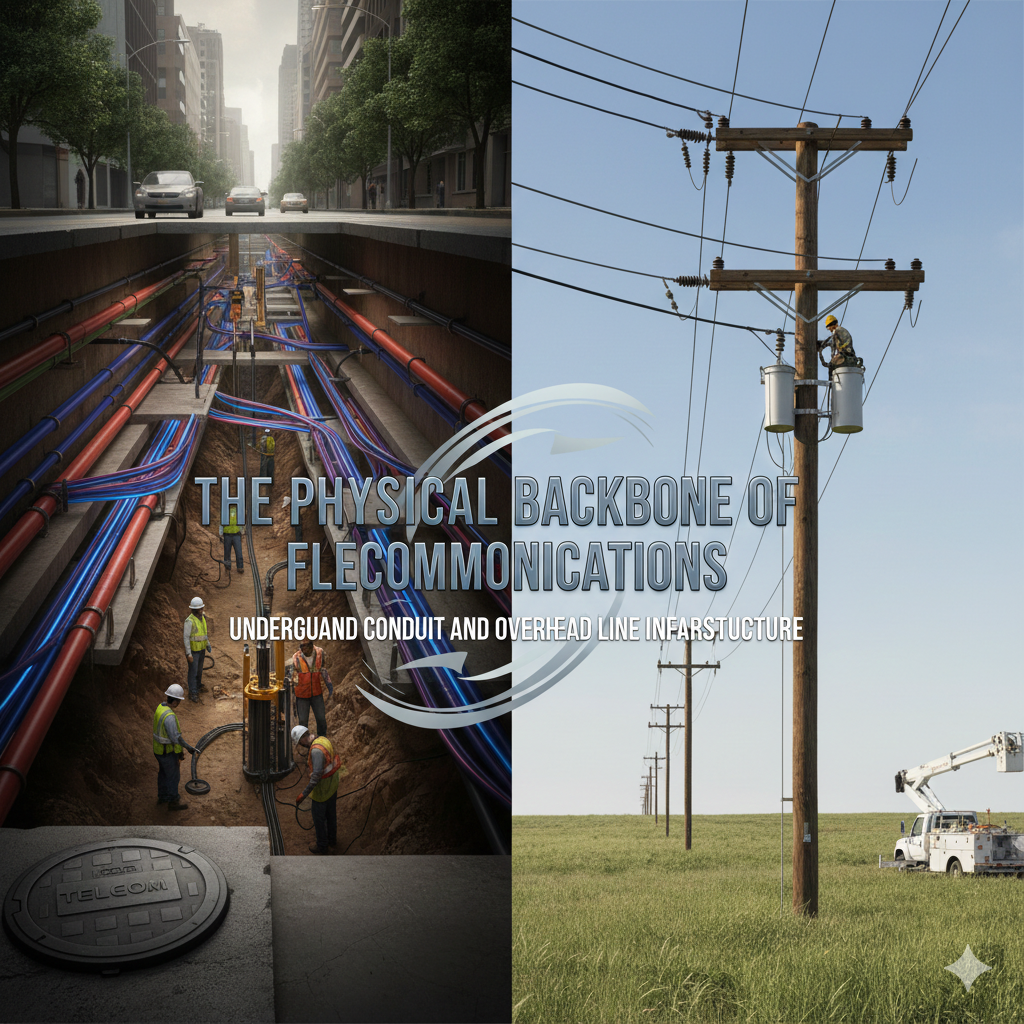
While modern telecommunications is often associated with wireless technologies—cell towers, satellites, and radio spectrum—the true backbone of global connectivity remains physical infrastructure. Fiber-optic cables, copper lines, conduit networks, poles, vaults, and support structures form the essential framework that enables nearly all digital communication. Underground conduit systems and overhead line networks are the foundational components of this physical layer, providing reliability, capacity, and scalability that wireless systems alone cannot replicate.
Underground conduit infrastructure is the most permanent and capital-intensive form of telecommunications construction. It consists of buried duct banks, conduits, handholes, manholes, vaults, and pull boxes designed to house fiber-optic and copper cables. These systems are typically installed beneath streets, sidewalks, utility corridors, and rights-of-way, often alongside water, sewer, electric, and gas infrastructure. Modern conduit systems are usually constructed from PVC, HDPE, or concrete-encased duct banks, providing physical protection from soil movement, groundwater intrusion, freeze-thaw cycles, and accidental excavation damage.
The primary advantage of underground conduit is durability and capacity. Once installed, conduit systems can support multiple generations of telecommunications technology without requiring repeated excavation. Empty ducts allow new fiber cables to be pulled through as bandwidth demand grows, enabling scalable upgrades without surface disruption. This makes conduit networks especially valuable in urban environments, dense commercial districts, and institutional campuses where repeated trenching would be economically and socially disruptive.
Underground systems also offer superior protection from environmental hazards. Storms, wind, ice, wildfires, vehicle impacts, and falling trees—common causes of service outages in overhead systems—have minimal effect on buried infrastructure. As climate volatility increases, this resilience becomes more critical for hospitals, financial systems, emergency services, and data centers that depend on continuous connectivity. For this reason, mission-critical networks often prioritize underground routing even when costs are higher.
However, underground infrastructure comes with significant challenges. Construction costs are high due to excavation, traffic control, permitting, utility coordination, and restoration requirements. Subsurface congestion in urban areas can make routing complex, requiring detailed utility mapping, vacuum excavation, and horizontal directional drilling. Maintenance and fault location can also be more technically demanding, requiring specialized testing equipment and access through vaults and manholes rather than visual inspection.
In contrast, overhead telecommunications infrastructure relies on utility poles, aerial messenger cables, strand systems, and pole-mounted hardware. Fiber and copper lines are attached to poles shared with electric utilities, cable providers, and municipal systems. This method offers lower initial installation costs, faster deployment, and easier access for repairs and upgrades. Rural and suburban areas in particular depend heavily on aerial infrastructure due to long distances, low customer density, and limited capital resources.
Overhead lines provide operational flexibility. Technicians can visually inspect cables, quickly identify faults, and perform repairs without excavation. Network expansions can often be completed by stringing new cable rather than constructing new pathways. This makes aerial systems economically efficient for rapid broadband deployment and rural connectivity initiatives.
Yet overhead infrastructure is inherently vulnerable. Weather events, vehicle collisions, vegetation growth, and ice loading regularly cause outages. Visual clutter, right-of-way conflicts, and pole congestion also present planning and safety challenges. As bandwidth demands increase, the physical loading on poles grows, sometimes exceeding structural limits and requiring pole replacement or reinforcement.
Together, underground and overhead systems form an integrated physical network that supports modern telecommunications. Fiber-optic cables running through conduits and along poles carry the data that enables wireless networks, cloud computing, streaming services, financial transactions, and emergency communications. Even the most advanced wireless systems ultimately depend on fiber backhaul and physical routing to connect antennas to data centers and network cores.
In this sense, wireless technology is not a replacement for physical infrastructure but a layer built upon it. The reliability, speed, and capacity of modern communication are determined not by radio waves alone, but by the quality, density, and design of conduit networks and overhead line systems. As data demand continues to grow exponentially, investment in this physical backbone will remain essential to economic stability, public safety, and technological progress.