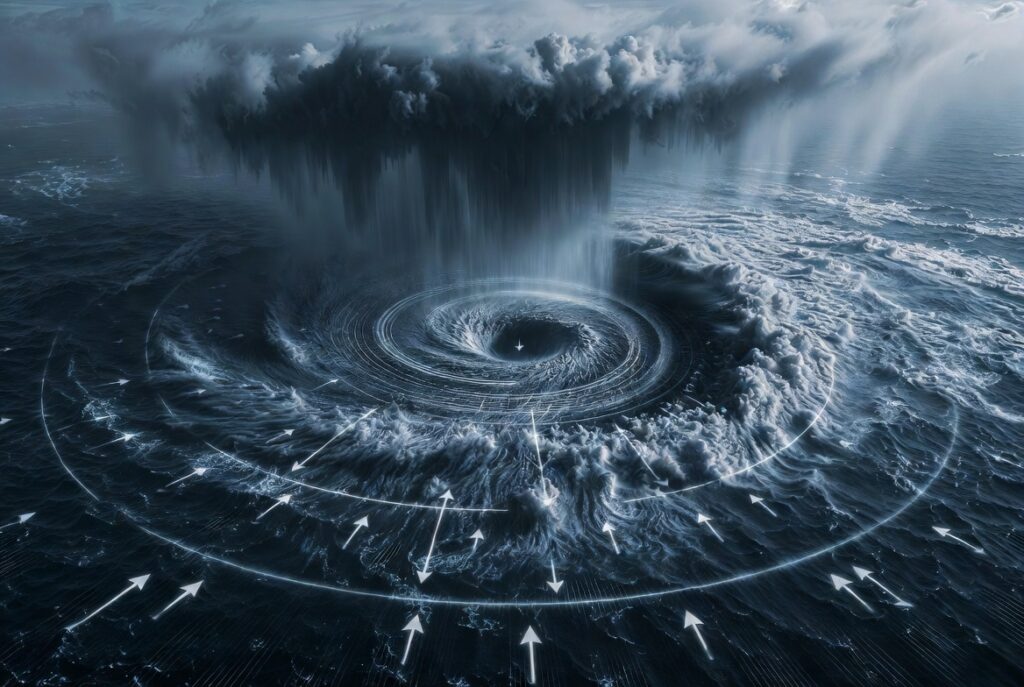
Low-pressure systems are fundamental drivers of weather, particularly rainfall, across much of the globe. From a meteorological and physical standpoint, these systems represent regions where atmospheric pressure at the surface is lower than that of the surrounding environment. This pressure differential initiates a cascade of processes—air convergence, vertical motion, cooling, condensation, and ultimately precipitation—that govern how and when rainfall occurs. Understanding these mechanisms requires examining both the thermodynamics of moist air and the dynamics of atmospheric circulation.
At the most basic level, air flows from regions of high pressure to low pressure due to the pressure gradient force. In a low-pressure system, this results in horizontal convergence of air near the surface. However, unlike a simple horizontal flow, the converging air has nowhere to go but upward. This vertical motion is the defining characteristic of low-pressure systems and is essential for rainfall formation. As air rises, it expands due to decreasing pressure with altitude, leading to adiabatic cooling. This cooling reduces the air’s capacity to hold water vapor, eventually bringing it to saturation.
Once saturation is reached, water vapor begins to condense onto microscopic particles known as cloud condensation nuclei—typically dust, salt, or other aerosols suspended in the atmosphere. This condensation process forms cloud droplets and releases latent heat, which further enhances buoyancy and sustains upward motion. The release of latent heat is particularly important in intensifying low-pressure systems, especially in tropical regions where warm, moist air is abundant. Over time, cloud droplets collide and coalesce into larger droplets. When these droplets become heavy enough to overcome updrafts, they fall as precipitation.
Different types of low-pressure systems produce rainfall through somewhat different mechanisms. In mid-latitudes, extratropical cyclones are the dominant form. These systems are associated with frontal boundaries—interfaces between air masses of different temperatures and densities. Warm fronts produce widespread, steady rainfall as warm air gradually ascends over cooler air. In contrast, cold fronts tend to generate more intense but shorter-lived rainfall due to the abrupt lifting of warm air by an advancing cold air mass. The geometry and speed of these fronts strongly influence rainfall distribution, duration, and intensity.
In tropical regions, low-pressure systems often manifest as tropical depressions, storms, or hurricanes. Here, the absence of strong temperature gradients shifts the emphasis toward convective processes. Warm ocean surfaces provide continuous heat and moisture, fueling deep convection. Air rises vigorously in localized columns, forming towering cumulonimbus clouds. Rainfall in these systems is typically intense and can be highly localized, though organized systems like hurricanes can produce widespread and prolonged precipitation. The efficiency of rainfall production in tropical systems is often higher due to the deep vertical extent of the clouds and the abundance of moisture.
Topography also plays a critical role in modulating rainfall associated with low-pressure systems. When moist air is forced to rise over elevated terrain—a process known as orographic lifting—it cools and condenses, enhancing precipitation on the windward side of mountains. Conversely, descending air on the leeward side warms and dries, creating rain shadow effects. In regions like Hawaii, this interaction between low-pressure-driven moisture transport and complex terrain results in highly variable rainfall patterns over relatively short distances.
From an engineering and hydrologic perspective, the behavior of low-pressure systems is directly tied to rainfall intensity-duration-frequency (IDF) relationships, which underpin stormwater design. The temporal structure of rainfall—whether a prolonged, moderate event or a short, intense burst—affects runoff generation, infiltration rates, and peak discharge. Low-pressure systems associated with slow-moving fronts or stalled tropical systems can produce significant cumulative rainfall, increasing the risk of flooding and soil saturation. Conversely, fast-moving systems may generate high peak intensities but lower total volumes.
Modern forecasting of low-pressure systems relies on numerical weather prediction models that solve the governing equations of fluid motion and thermodynamics. These models assimilate data from satellites, radar, and ground observations to predict the evolution of pressure fields, moisture content, and vertical motion. Despite advances, challenges remain, particularly in predicting the precise location and intensity of rainfall, which depend on small-scale processes such as convection and microphysics.
In summary, low-pressure systems are central to the formation of rainfall through their ability to induce rising motion, cooling, and condensation of moist air. Whether in the form of mid-latitude cyclones or tropical convective systems, the underlying physics remains consistent: convergence at the surface leads to ascent, cloud formation, and precipitation. The variability in rainfall patterns arises from differences in system structure, atmospheric conditions, and local geography. For engineers, meteorologists, and planners alike, understanding these processes is essential for managing water resources, designing resilient infrastructure, and mitigating the impacts of extreme weather.