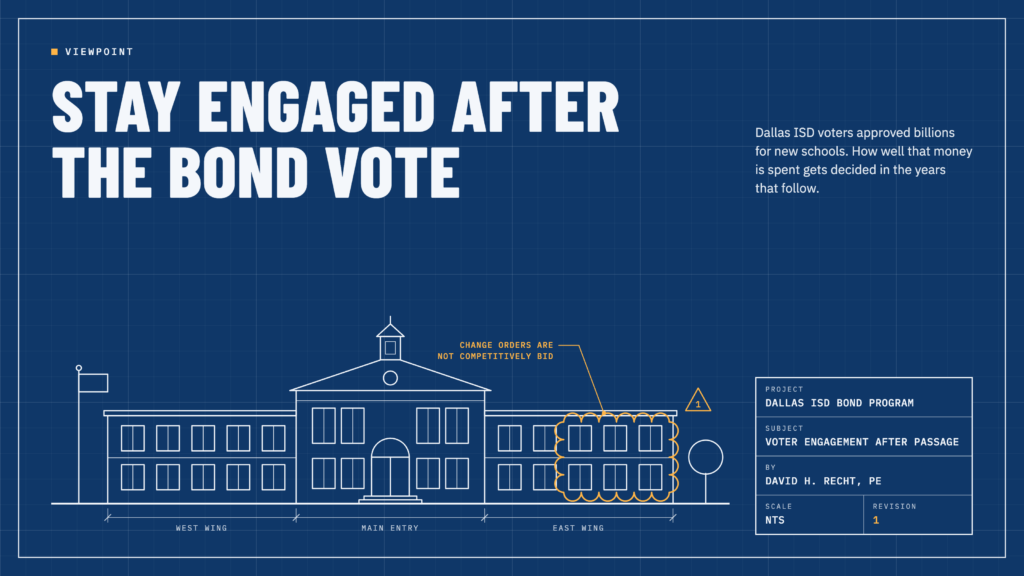
Dallas ISD recently passed a multi-billion dollar bond issue. Elections of this type frequently pass, and frequently lose sight of the public eye after-the-fact. However, the months and years following passage are perhaps more important than the run-up to the election.
Education is, clearly, an important priority, securing bipartisan support in elections. As is the case with many school districts, facilities are nearing (or past) the end of their life cycles, and their reconstruction is near universally encouraged, and necessary.
The key is for this rebuilding to be done efficiently. When I was at the City of Dallas in 2006, the City sold its first billion dollar bond issue. The funds were used for transportation, drainage, parks, facilities, and other infrastructure. The bonds were general obligation bonds, backed by the city’s ability to secure revenue as a taxing agency (water and sewer infrastructure are typically funded as revenue bonds, in which bond holders are secured by collateral associated with the user-fees associated with metered usage of city infrastructure). The city was not staffed to sell all the bonds that voters authorized in one sale, so it would stagger the sales across multiple fiscal years. Infrastructure projects typically take months (more often, years) to construct, so the sale of bonds was staggered so as not to incur interest payments on the debt for longer periods than needed. Bond funds from the 2006 election would take years to spend, simply because the city lacked the resources to manage large amounts of infrastructure projects simultaneously, which brings us back to Dallas ISD.
It is important for us, the voters, to stay engaged with the district beyond the election. Bond issues of such a massive scale need to be managed efficiently, not only in the timing of the sales, but in nuts-and-bolts, project-by-project, management of each construction project.
These best practices need to start during initial design, by careful selection of architectural and engineering consultants, surveyors, and other professionals. Good design can lead to substantial savings in construction, particularly in minimizing change orders, which are not competitively bid (EG once a contractor has been awarded a low-bid contract, subsequent modifications to the contract are no longer “low bid”, since there’s only one entity engaged by the district after the start of construction). This underscores the need for clear, efficient construction plans. Our taxpayer dollars are either judiciously spent, or wasted, in the years following our electoral decision to proceed with billions of dollars of new school campuses.
We have agreed, as the citizens of Dallas, to proceed in a massive investment for future generations. Good classrooms lead to good education, which we all agree is needed. Our job now, as voters, is to stay engaged with our district, by being involved in our neighborhood schools, and by staying engaged with the district and asking questions, showing interest, and following up with the massive investment that we’ve committed to building.