Lighthouses are among the most elegant intersections of civil, structural, and optical engineering. Built to guide mariners through hazardous coastlines, shoals, and harbor entrances, they embody a blend of durability, precision, and visibility. While they may appear simple from a distance—a tower with a light—their design involves complex considerations of structural stability, environmental loading, optics, and long-term reliability.
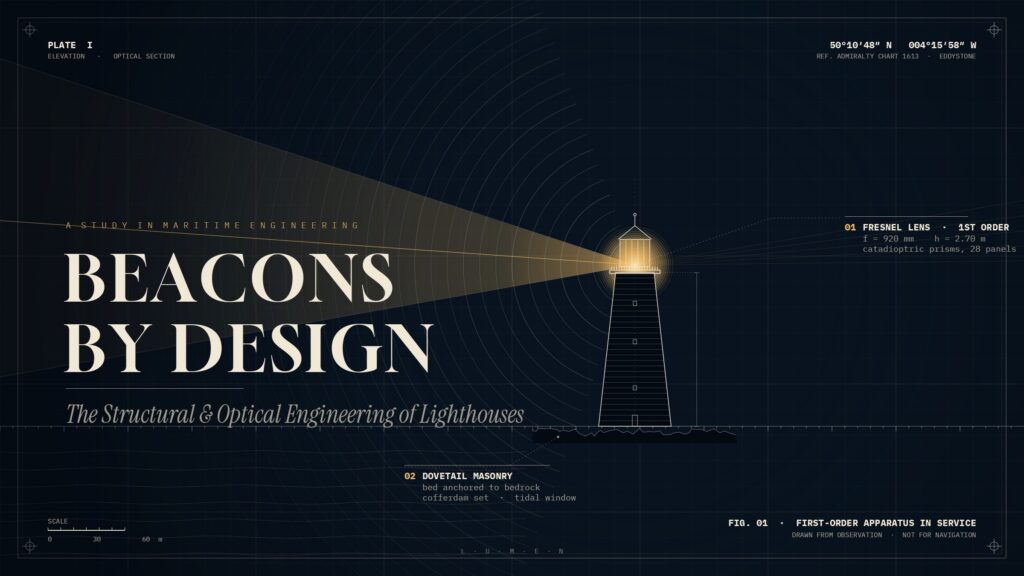
At the core of lighthouse engineering is the structural challenge. Most lighthouses are located in extreme environments: rocky cliffs, isolated reefs, or barrier islands subject to hurricanes and storm surge. Early masonry towers relied on thick stone walls and tapered profiles to resist overturning and wave impact. The classic conical or cylindrical geometry is not aesthetic alone—it reduces wind loading and improves stability by lowering the center of gravity. Offshore lighthouses such as the famous Eddystone Lighthouse represent some of the earliest examples of wave-resistant design. Engineers developed interlocking stone blocks and dovetail joints to ensure that individual stones could not be dislodged by repeated wave forces. Modern lighthouses often use reinforced concrete or steel, but the fundamental principle remains: resist lateral loads while maintaining a stable, long-lasting structure.
Foundation design is equally critical. Onshore lighthouses may use spread footings or deep piles depending on soil conditions, while offshore structures require anchoring directly into bedrock. In many historic cases, engineers had to work within narrow tidal windows, setting foundations in submerged or partially exposed rock. Grouting techniques, cofferdams, and precise surveying were essential even before modern equipment existed. The durability of these foundations is remarkable—many have survived over a century of relentless marine exposure.
The optical system is the defining feature of a lighthouse. Early designs used open flames or simple lamps, but the breakthrough came with the invention of the Fresnel lens in the 19th century. This lens uses concentric rings of glass prisms to focus light into a powerful, concentrated beam visible for miles. From an engineering standpoint, the Fresnel lens is a masterpiece of optical efficiency, reducing the amount of material needed while maximizing transmission. Different “orders” of Fresnel lenses correspond to size and focal length, allowing engineers to tailor visibility range based on geographic need.
Rotation mechanisms further enhance identification. Each lighthouse has a unique flash pattern—achieved through rotating lenses or timed shutters—so mariners can distinguish one beacon from another. Historically, these systems were driven by clockwork mechanisms powered by descending weights, requiring periodic manual winding. Modern systems use electric motors and automated controls, but the principle of distinct signaling remains unchanged.
Lighting technology has also evolved significantly. Oil lamps gave way to incandescent bulbs, then halogen lamps, and now high-efficiency LEDs. LEDs offer lower energy consumption, longer service life, and compatibility with solar power systems, which is particularly valuable for remote, unmanned stations. Solar panels, battery storage, and automated monitoring have transformed lighthouse operations, reducing the need for full-time keepers.
Environmental resilience is another key engineering consideration. Lighthouses must withstand corrosion from salt spray, thermal expansion, and biological growth such as algae or barnacles. Protective coatings, corrosion-resistant alloys, and regular maintenance regimes are essential to prolong service life. In colder regions, ice loading can impose additional stresses, requiring reinforced designs and careful material selection.
Finally, redundancy and reliability are paramount. A lighthouse is a safety-critical system—failure can result in shipwrecks and loss of life. For this reason, many designs incorporate backup power systems, secondary light sources, and fail-safe controls. Even in modern navigation systems dominated by GPS, lighthouses remain a crucial visual aid and a resilient fallback in case of electronic failure.
In sum, lighthouse engineering is a multidisciplinary achievement, combining structural robustness, optical precision, and operational reliability. These structures stand not only as navigational aids but also as enduring symbols of engineering ingenuity in the face of nature’s most demanding conditions