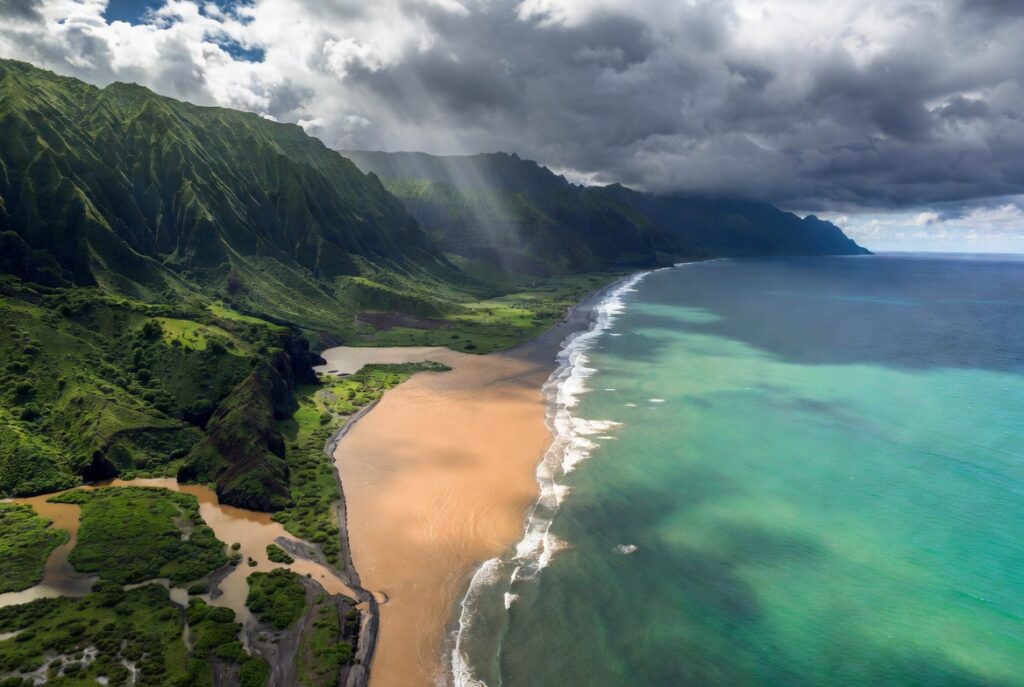
Brown water advisories in Hawaiʻi represent a uniquely local intersection of hydrology, wastewater infrastructure, and coastal engineering. From a civil engineering perspective, they are not merely public health warnings but visible indicators of watershed-scale system performance—revealing how land use, drainage design, and legacy infrastructure interact under storm loading.
Definition and Context
A brown water advisory (BWA) is issued by the Hawaiʻi Department of Health when nearshore waters become turbid or contaminated, typically following rainfall events. These advisories are triggered when stormwater runoff carries land-based pollutants—sediment, nutrients, pathogens, and chemicals—into coastal waters via streams, drainage canals, and storm drains. Unlike mainland beach closures based primarily on bacterial sampling, Hawaiʻi’s BWAs are often predictive and tied to hydrologic events such as flash flood warnings.
From an engineering standpoint, BWAs are a direct consequence of short, steep watersheds. Rainfall in upland areas rapidly concentrates and reaches the ocean, often within hours. This creates a system where runoff transport is efficient but largely untreated.
Causes: A Systems-Level Perspective
1. Stormwater Runoff and Sediment Transport
The primary driver of brown water events is intense rainfall. Hawaiʻi’s volcanic topography produces steep gradients and highly erodible soils. During storm events, overland flow entrains:
- Fine sediments (causing turbidity and the “brown” appearance)
- Nutrients (nitrogen, phosphorus)
- Urban pollutants (oils, metals)
This runoff is conveyed through natural streams and engineered drainage systems directly to the ocean.
Civil engineering implication: many drainage systems are designed for flood conveyance, not water quality treatment. Unlike mainland systems with detention basins or green infrastructure, Hawaiʻi’s rapid conveyance prioritizes flood risk reduction over pollutant attenuation.
2. Wastewater Infrastructure Limitations (Cesspools and Septic Systems)
A defining contributor in Hawaiʻi is the widespread use of cesspools—essentially unlined pits that discharge untreated sewage into the ground. These systems:
- Directly contaminate groundwater
- Introduce pathogens and nutrients into coastal waters
- Can overflow or mobilize during heavy rain events
Estimates suggest tens of thousands of cesspools discharge millions of gallons of untreated wastewater daily.
From an engineering perspective, this represents a non-point source pollution problem embedded in legacy infrastructure. Unlike centralized sewer systems, cesspools lack treatment processes such as sedimentation, biological digestion, or disinfection.
3. Combined Effects: Hydrology + Infrastructure
The most critical insight is that brown water advisories are not caused by a single failure but by system coupling:
- Rainfall mobilizes pollutants
- Watersheds rapidly convey flow
- Aging or inadequate wastewater systems supply contaminants
Additionally, infrastructure failures—such as sewer overflows or pipeline breaks—can exacerbate events, introducing raw sewage into waterways.
4. Climate and Extreme Events
Increasing rainfall intensity and storm frequency amplify these issues. Flooding events can:
- Overwhelm drainage systems
- Cause landslides and erosion
- Mobilize previously deposited contaminants
This introduces a nonlinear response, where pollutant loads increase disproportionately with storm magnitude.
Resolution: Engineering Pathways
1. Natural Attenuation and Short-Term Recovery
In the immediate term, brown water conditions typically resolve through physical and biological processes:
- Dilution via tidal mixing
- Sediment settling
- Ultraviolet disinfection from sunlight
Coastal waters often return to acceptable conditions within 48–72 hours after rainfall ceases, depending on wave energy and flushing rates.
From a coastal engineering perspective, this reflects the effectiveness of natural flushing regimes, particularly in high-energy shorelines.
2. Stormwater Management Improvements
Long-term mitigation requires redesigning stormwater systems to incorporate water quality treatment. Potential strategies include:
- Detention and retention basins to slow runoff
- Bioswales and vegetated buffers to filter pollutants
- Sediment traps at stream outlets
However, Hawaiʻi’s steep terrain and limited land availability constrain traditional approaches, requiring compact or decentralized solutions.
3. Wastewater Infrastructure Upgrades
The most significant long-term solution is the elimination of cesspools and transition to:
- Septic systems with leach fields
- Advanced treatment units (e.g., denitrification systems)
- Centralized sewer connections where feasible
State policy now mandates conversion of cesspools by 2050, though cost and logistics remain major barriers.
This represents a classic civil engineering challenge: replacing distributed, low-cost systems with higher-performance infrastructure across difficult terrain and dispersed communities.
4. Watershed-Based Planning
Modern engineering practice increasingly focuses on integrated watershed management, which includes:
- Land use controls to reduce erosion
- Reforestation and soil stabilization
- Monitoring and modeling pollutant transport
This approach recognizes that coastal water quality is fundamentally a watershed problem, not just a shoreline issue.
Conclusion
Brown water advisories in Hawaiʻi are a visible manifestation of interconnected civil engineering systems under stress. They arise from the coupling of steep watershed hydrology, rapid stormwater conveyance, and legacy wastewater infrastructure—particularly cesspools.
Their resolution operates on two timescales: short-term natural flushing and long-term infrastructure transformation. For engineers, the challenge is to redesign systems that balance flood control, environmental protection, and economic feasibility in a uniquely constrained island setting.
In that sense, every brown water event is both a warning and a diagnostic tool—revealing where the built environment and natural systems are out of alignment, and where future engineering efforts must focus.