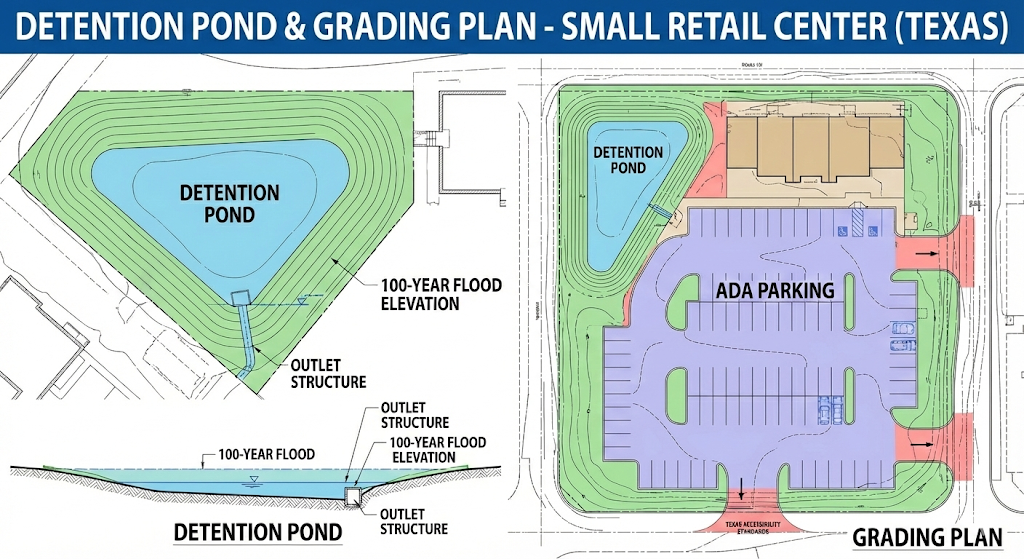
Designing a detention pond and grading plan for a small retail strip center—particularly one under five acres in Texas—requires a careful balance of regulatory compliance, constructability, cost control, and long-term functionality. When ADA-accessible parking is part of the site program, the grading strategy becomes even more critical, because drainage, slopes, and accessibility standards are tightly interrelated. The goal is to move stormwater safely, meet municipal and state requirements, and deliver a site that is both usable and resilient.
In Texas, detention pond design is typically governed by local drainage criteria manuals, which often build on principles from the Texas Department of Transportation (TxDOT), the Harris County Flood Control District (in Houston-area jurisdictions), or other regional authorities. Most municipalities require post-development runoff rates to be limited to pre-development levels for specific design storms, commonly the 2-, 10-, 25-, and 100-year events. For a retail strip center under five acres, the detention pond is usually a dry-bottom basin sized to temporarily store excess runoff and release it slowly through a controlled outlet structure. The first step is hydrologic modeling—often using the Rational Method for smaller sites or more advanced software like HEC-HMS—to estimate runoff volumes and peak flows based on soil type, impervious cover, rainfall intensity, and time of concentration.
Once the required detention volume is established, the basin geometry is developed. On a constrained commercial site, the pond is often placed along a rear or side property line to preserve frontage and building pad area. Side slopes must satisfy both safety and maintenance considerations; a common standard is 3H:1V or flatter, with 4H:1V preferred where space allows. The basin floor is graded to promote positive drainage toward the outlet, avoiding standing water beyond the allowable drawdown period—typically 24 to 48 hours. In Texas soils, which can range from sandy loams to expansive clays, subgrade treatment and erosion protection are essential to maintain long-term performance.
The outlet structure usually consists of a combination of orifices and a weir or riser to control release rates for multiple storm events. A low-flow orifice handles frequent storms, while a higher weir or overflow crest safely passes extreme events. The outlet discharges to a public storm sewer, roadside ditch, or natural channel, subject to downstream capacity and municipal approval. An emergency spillway is also incorporated, set slightly above the design high-water level, to safely convey flows if the primary outlet becomes obstructed.
Grading the overall site must integrate seamlessly with the detention pond design. The building pad is typically elevated above the 100-year flood elevation and any known offsite overland flow paths, with a minimum freeboard specified by local codes. From the pad, the site is graded to direct runoff toward inlets and surface swales that lead to the detention basin. Positive drainage is mandatory; no paved or landscaped area should rely on ponding to remove water unless explicitly designed as part of a bioretention feature.
ADA parking adds another layer of precision. Under the Americans with Disabilities Act and the Texas Accessibility Standards (TAS), accessible parking spaces and access aisles must not exceed a 2% slope in any direction. This requirement strongly influences the grading plan near the building entrance. The pavement cross slopes must be tightly controlled, often requiring localized flat grading “tabletops” around accessible spaces, curb ramps, and pedestrian routes. Drainage structures must be carefully positioned so that water does not sheet across ADA spaces or flow through access aisles, which would create usability and safety issues.
To reconcile drainage needs with ADA slope limits, designers often introduce trench drains, shallow valley gutters, or closely spaced inlets along the edge of the ADA parking zone. These features intercept runoff without forcing excessive pavement slopes. The grading transitions from the flat ADA-compliant areas to steeper slopes in general parking or drive aisles, still respecting maximum slopes for vehicular safety and code compliance.
Erosion and sediment control measures are integral to both the detention pond and grading plan. During construction, silt fences, rock check dams, and stabilized construction entrances prevent sediment from clogging storm structures or leaving the site. Permanent stabilization—such as turf reinforcement mats on pond slopes and native grasses on embankments—ensures long-term durability, especially during intense Texas rain events.
Ultimately, designing a detention pond and grading plan for a small retail strip center in Texas is an exercise in integration. Hydrology, hydraulics, accessibility, constructability, and regulatory requirements must all be satisfied within a compact footprint. When executed well, the result is a site that drains efficiently, remains accessible to all users, complies with local and state standards, and performs reliably through the full range of Texas weather conditions.