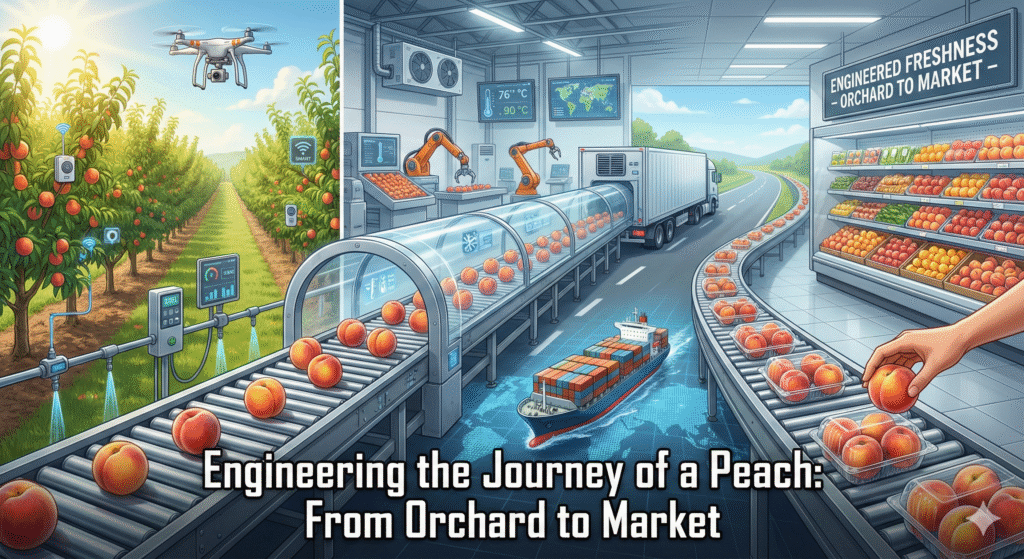
Peaches feel simple—soft skin, fragrant flesh, a short season, and a strong emotional pull toward summer. But from an engineering and logistics perspective, a peach is one of the more demanding agricultural products in modern supply chains. It is biologically fragile, chemically active, seasonally compressed, and geographically uneven in production. Getting a peach from orchard to consumer without bruising, fermenting, or degrading quality is less a pastoral exercise and more a precision logistics operation.
Production begins with systems engineering long before fruit appears. Orchard design is increasingly optimized for mechanization and logistics rather than just agronomy. Tree spacing, row alignment, slope grading, and irrigation layout are coordinated to support vehicle access, harvest flow, and water efficiency. Drip irrigation systems are now standard, using pressure-regulated emitters and sensor feedback loops that balance soil moisture, salinity, and evapotranspiration. This isn’t just about yield—it’s about predictability. Uniform fruit size and ripening windows simplify downstream sorting, packing, and transport scheduling.
Harvesting peaches is a narrow operational window problem. Unlike apples or citrus, peaches have a short optimal maturity window and a low tolerance for mechanical stress. Most harvesting remains manual, but logistics engineering dominates the process. Crews are staged by block maturity mapping, harvest routes are sequenced to minimize field dwell time, and bin logistics are tightly choreographed. Field bins are often padded, ventilated, and standardized to interface with forklifts and conveyors at packing houses. The goal is not speed alone—it’s minimizing cumulative handling energy. Every lift, drop, and transfer increases micro-bruising risk.
Once picked, peaches immediately enter what is essentially a race against biology. Respiration rates are high, ethylene production accelerates ripening, and moisture loss degrades texture. This is where post-harvest engineering becomes decisive. Hydrocooling systems rapidly pull field heat out of the fruit using chilled water circulation, often within minutes of harvest. Forced-air cooling tunnels then bring pulp temperatures down to transport-stable ranges. These systems are designed around airflow modeling, heat transfer coefficients, and throughput constraints, not agricultural tradition.
Sorting and grading introduce another layer of industrial engineering. Modern packing lines use optical scanners, near-infrared sensors, and machine vision to assess size, color, sugar content proxies, and surface defects. Peaches are routed algorithmically into grade streams that determine destination markets and transport priority. A premium retail peach and a processing peach may come off the same tree but enter completely different logistics pipelines.
Transport is where peaches become a true systems problem. Refrigerated trucking dominates short-haul distribution, while rail refrigeration and intermodal containers handle longer distances. Temperature control is not static—it’s dynamic. Controlled atmosphere transport regulates oxygen and carbon dioxide levels to slow respiration, while humidity control systems prevent dehydration. Shock and vibration mitigation is also engineered into packaging design: stack strength, airflow channels, and cushioning geometry are optimized for both pallet stability and airflow efficiency.
Routing algorithms matter as much as refrigeration. Time-to-market is tightly coupled to quality retention. Distribution networks are designed to minimize transshipment nodes, reduce dwell times, and synchronize with retail receiving schedules. A peach delayed in a distribution center loses value faster than almost any other fruit. Logistics planners treat peaches more like pharmaceuticals than produce—time-sensitive, condition-sensitive, and risk-weighted.
Even packaging is an engineering compromise. Ventilation holes improve cooling but reduce structural integrity. Cushioning materials protect fruit but trap heat. Plastic reduces moisture loss but increases condensation risk. Every crate design is a trade study between thermodynamics, material science, transport economics, and damage probability modeling.
From orchard layout to refrigerated routing algorithms, peach logistics is not pastoral—it’s industrial choreography. The consumer sees a soft, fragrant fruit in a grocery display. Behind it is a tightly coupled system of sensors, cooling systems, routing models, materials engineering, and biological constraints working in synchrony. A peach may feel natural, but its journey is engineered—carefully, continuously, and under pressure from both time and physics.
In the end, peach logistics is a reminder of a broader truth: modern agriculture is not just biology. It is infrastructure, systems design, and logistics engineering operating in living materials. And the softer the product, the harder the engineering has to work.