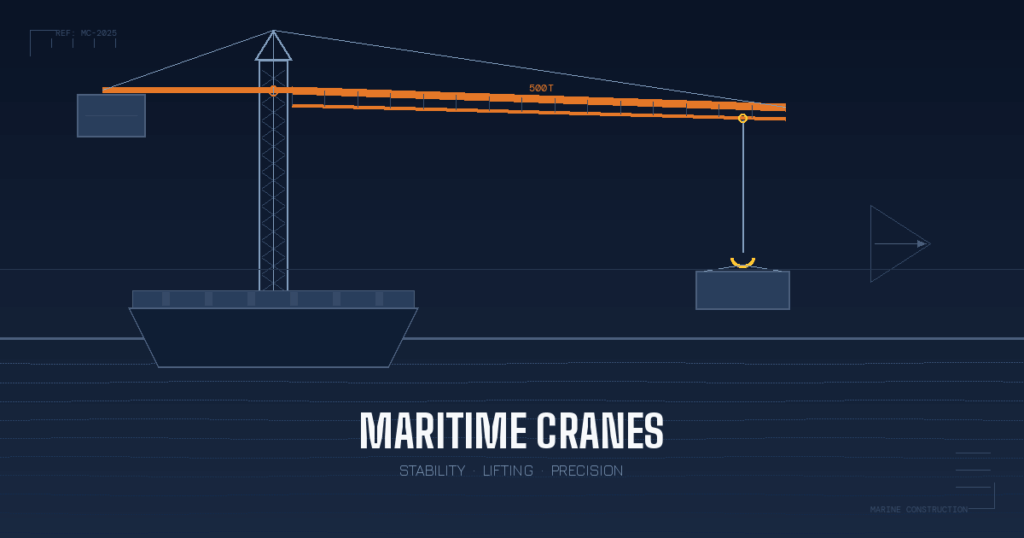
In marine construction, cranes are among the most critical — and complex — pieces of equipment on any job site. Unlike land-based cranes, maritime cranes must operate on moving platforms, contend with waves and currents, and maintain stability while lifting massive loads with extreme precision.
From bridge construction and port expansion to offshore foundations and heavy industrial installations, understanding how maritime cranes function is essential for engineers working in coastal, riverine, and offshore environments.
This article provides a practical overview of how marine cranes operate, how stability is maintained, and why crane–vessel interaction is one of the most important engineering considerations in marine construction.
The Fundamental Challenge: Lifting From a Floating Platform
The defining difference between land cranes and maritime cranes is simple but profound: the crane is not standing on fixed ground.
It is mounted on a barge, a floating platform, a crane vessel, or a self-elevating jack-up system.
This introduces three primary engineering challenges:
- Platform motion – heave, roll, and pitch from waves and vessel movement
- Changing stability – load weight shifts the vessel’s center of gravity
- Environmental forces – wind, current, and wave loading affect both the lift and the hull
Every heavy lift at sea is therefore a coupled structural and naval engineering problem.
Types of Maritime Cranes Commonly Used in Marine Construction
Several crane configurations dominate marine projects:
Floating Sheerleg and Heavy Lift Cranes
Used for bridge segments, large precast elements, offshore modules, and industrial equipment. These cranes may lift 500 to 10,000+ tons, often with fixed booms and limited slewing.
They rely heavily on ballast control, hull form stability, and pre-engineered lift plans.
Pedestal and Revolving Cranes on Barges
Common for pile driving, sheet pile installation, deck construction, and general marine lifting. These cranes operate with full slewing capability, multiple load radii, and continuous repositioning.
They are typically supported by spud barges, anchored barges, or moored platforms.
Offshore and Knuckle Boom Cranes
Used in offshore platforms, wind energy, and modular installation. These cranes emphasize compact geometry, high control accuracy, and motion compensation in some advanced systems.
Stability: The Central Engineering Problem
The most important technical issue in maritime crane operations is global stability.
When a crane lifts a load, the combined center of gravity shifts, the righting moment of the vessel decreases, and heel and trim change dynamically.
Engineers must evaluate:
- Metacentric height (GM)
- Righting arm curves (GZ curves)
- Allowable heel angles
- Dynamic amplification factors
A lift that is perfectly safe on land can become dangerous at sea if load radius is too large, freeboard becomes insufficient, or stability margins are reduced below design thresholds.
This is why most heavy marine lifts require naval architect review, stability calculations for each lift stage, and pre-ballasting and de-ballasting plans.
Crane–Vessel Interaction: Why Small Boats Matter
In many marine construction projects, cranes do not work alone. They interact with tugboats, material barges, pile templates, and service vessels.
This introduces additional complexity: contact forces during positioning, load transfer during pick-and-place operations, and relative motion between crane barge and supply vessel.
For example, when a small service vessel pushes against a crane barge to help align a load, engineers must consider local hull stresses, fender reactions, mooring line tensions, and crane boom load path effects.
Poor coordination between vessels can introduce unexpected lateral loads, shock loading, and dangerous oscillations. This is why marine lifts often rely on detailed lift sequencing, tug choreography, and real-time communication between crane operator, captain, and rigging crew.
Foundations, Piles, and Precision Placement
Marine cranes are rarely just lifting devices. They are central to pile driving operations, caisson placement, sheet pile installation, and bridge substructure construction.
Here precision matters as much as capacity. Engineers must control verticality of piles, rotational alignment of templates, penetration resistance, and impact energy transfer.
Dynamic effects become important: hammer mass and drop height, soil–structure interaction, crane boom stiffness, and platform movement during driving.
This is why crane selection is tightly integrated with geotechnical design, structural detailing, and installation methodology.
Environmental Forces and Operational Limits
Marine crane operations are governed by strict environmental criteria. Typical limits include maximum wind speed, maximum wave height, current velocity thresholds, and visibility constraints.
Engineers routinely model wind-induced overturning moments, wave-induced dynamic amplification, and fatigue effects on boom and rigging.
Operations may be suspended not because the crane cannot lift — but because control and stability margins become too small. In high-value lifts, motion monitoring systems and weather windows are critical risk controls.
Why Maritime Cranes Remain an Engineering Art as Much as a Science
Despite advanced modeling tools, maritime crane operations still rely heavily on experience, judgment, sequencing strategy, and crew coordination.
Every lift is a temporary structure — the crane, the barge, the rigging, the load, and the mooring system — all interacting in real time.
This is why marine construction remains one of the most interdisciplinary fields in civil and structural engineering, combining structural mechanics, naval architecture, geotechnical engineering, construction engineering, and risk management.
Final Thoughts
Maritime cranes are far more than oversized lifting machines. They are precision engineering systems operating in one of the most complex environments in construction.
From stability and vessel interaction to foundation installation and environmental control, successful marine lifting depends on careful planning, interdisciplinary design, and disciplined execution.
For engineers working in ports, bridges, offshore energy, and coastal infrastructure, understanding these systems is not optional — it is fundamental to safety, performance, and project success.