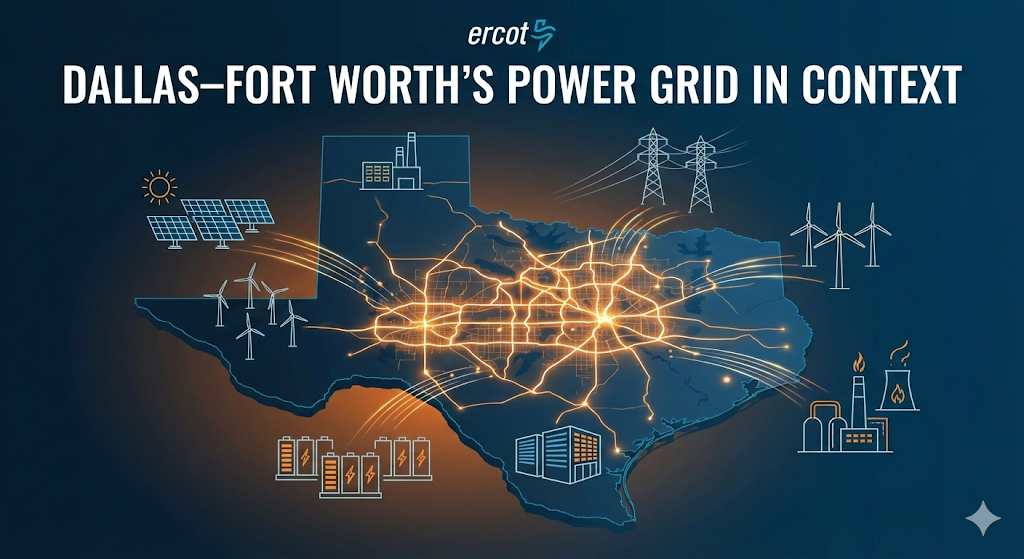
Dallas–Fort Worth’s Power Grid in Context
The Dallas–Fort Worth metroplex — one of the fastest-growing regions in the United States — is powered as part of the Texas electric grid managed by the Electric Reliability Council of Texas (ERCOT). ERCOT is the independent system operator (ISO) that controls the flow of electricity across most of Texas, including DFW. It manages a network of more than 46,500 miles of high-voltage transmission lines and over 610 generation units serving millions of homes and businesses.
Unlike most U.S. power grids, ERCOT is largely isolated from neighboring states. This gives Texas unique flexibility in how it regulates, generates, and distributes electricity — but it also limits the ability to import power during emergencies.
Sources of Power
Electricity in DFW comes from a diverse mix of generation sources that reflect broader trends across ERCOT:
- Natural Gas: Remains the largest single source of electricity. Natural gas plants provide the flexible, dispatchable power needed when demand spikes or intermittent sources like solar and wind drop off. Historically, gas accounted for about half of ERCOT’s generation.
- Wind Power: Texas leads the nation in wind energy. Wind farms across West Texas and the Panhandle contribute a significant portion of electricity, particularly at night or when breezes are strong.
- Solar Energy: Solar output has grown explosively in recent years. In 2025, utility-scale solar generated more power than coal for the first time in Texas history, underscoring the rapid rise of renewables in the state’s energy mix.
- Coal and Nuclear: Coal’s share has declined as older plants retire and renewables expand. Two nuclear plants — South Texas Project and Comanche Peak near DFW — provide steady, carbon-free baseload power.
- Battery Storage: An increasingly important part of the grid, batteries store excess energy from solar and wind and release it when needed, helping smooth fluctuations in supply and demand.
Together, these sources make up a complex energy mix that continually shifts with market forces and technological advances.
Transmission and Distribution
Getting electricity from distant generators to homes and businesses in DFW involves a layered system:
- High-Voltage Transmission: Long-distance transmission lines carry bulk power from generation sites (like West Texas wind farms or gas plants) to major load centers such as Dallas and Fort Worth. ERCOT oversees this grid and selects which generators are dispatched based on real-time demand and cost.
- Competitive Renewable Energy Zones (CREZ): A major 2013 initiative built transmission capacity to bring wind energy from resource-rich regions into populous areas, including DFW. Without CREZ, much of West Texas wind couldn’t reliably reach urban demand centers.
- Distribution Utilities: Once power reaches substations near the metroplex, utilities like Oncor — the primary distribution provider for DFW — step in to deliver electricity through lower-voltage lines to homes and businesses. These companies also plan local upgrades to handle growth and maintain reliability.
Demand Dynamics
Dallas–Fort Worth’s power demand has grown rapidly due to population increases, economic activity, and electrification trends (“everything is electric now”). Peak load records have climbed year after year. ERCOT forecasts that by 2030, peak demand on the Texas grid could nearly double from current levels, driven in part by new industrial loads.
A particularly notable local factor is the boom in data centers — DFW hosts one of the largest concentrations in the country. Collectively, these facilities already draw hundreds of megawatts and represent a significant demand source, sometimes comparable to small cities.
Balancing this demand with reliable supply — especially during extreme weather — remains a core challenge for planners. ERCOT has faced historic stress during heat waves and winter storms and has made changes to improve reliability since the 2021 outages.
History and Resilience
Texas’s power grid evolved over decades from a collection of local utilities into a competitive market. Deregulation in the late 1990s and early 2000s introduced wholesale competition, reshaping investment and pricing incentives.
The 2021 winter storm — when frozen infrastructure led to widespread outages — was a watershed moment. It exposed vulnerabilities in weatherization standards and spurred new rules for grid planning and generator performance, aiming to prevent future failures.
Looking Ahead: The Future Grid
The future of DFW’s power grid will be shaped by several forces:
- Renewable Integration: Wind and solar will continue to grow rapidly, supported by falling costs and demand for clean power. Already, renewables accounted for record portions of generation in 2025.
- Energy Storage: Batteries will play a bigger role in managing variable renewable output, improving reliability during peak times or unexpected outages.
- Transmission Expansion: To meet future demand — including from AI-driven loads — Texas plans thousands of miles of new transmission lines, an endeavor that could cost tens of billions and reshape how power flows into metro regions.
- Market and Policy Changes: Debates over how to incentivize capacity, reliability, and resilience continue at the Public Utility Commission and legislative levels.
Conclusion
The Dallas–Fort Worth power grid is a dynamic system embedded within the larger Texas grid. Its evolution — from aging fossil infrastructure to a diverse portfolio with abundant renewables and storage — reflects broader trends in technology, policy, and demand. Meeting the region’s future energy needs will require innovation in generation, transmission, and planning to ensure reliable, affordable power for one of America’s fastest-growing areas.