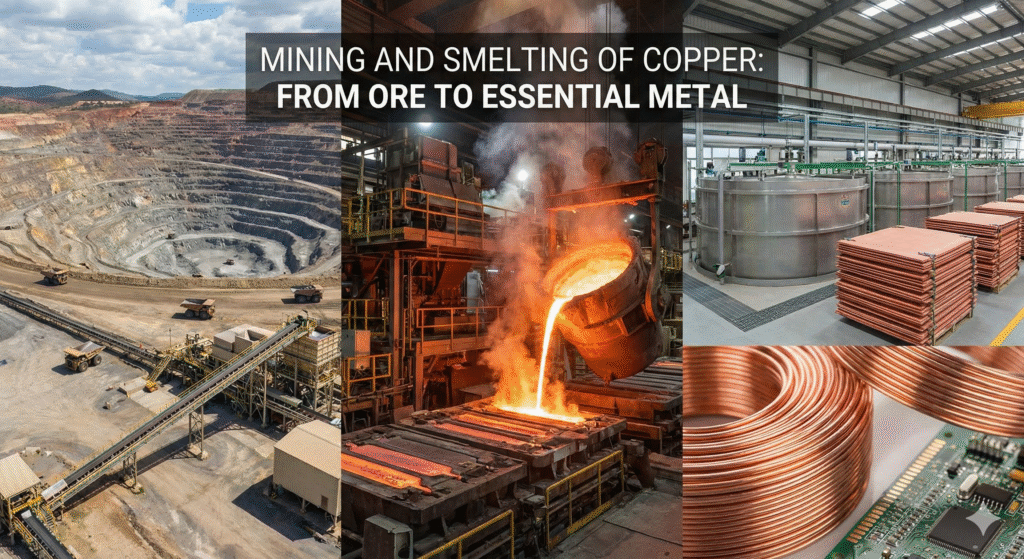
Copper has been central to human technological development for over 10,000 years, shaping civilizations from the Bronze Age to the modern digital economy. Its unique combination of electrical conductivity, corrosion resistance, ductility, and recyclability makes it indispensable in infrastructure, energy systems, transportation, and electronics. Behind every copper wire or pipe lies a complex industrial chain of mining, concentration, smelting, and refining—each stage involving sophisticated engineering, chemistry, and environmental management.
Copper mining begins with geological exploration and ore extraction. Economically viable copper ores are typically sulfide minerals such as chalcopyrite (CuFeS₂), bornite (Cu₅FeS₄), and chalcocite (Cu₂S), or oxide minerals like malachite and cuprite. Large-scale copper production usually occurs in open-pit mines, where massive earthmoving equipment removes overburden to access low-grade ore bodies, often containing less than 1% copper by mass. Underground mining is also used where ore bodies are deep or structurally constrained. Once extracted, the ore is crushed and ground into fine particles to liberate copper-bearing minerals from surrounding rock.
The next step is concentration, most commonly achieved through froth flotation. In this process, chemical reagents selectively attach to copper sulfide particles, making them hydrophobic. Air bubbles introduced into flotation cells carry these particles to the surface, forming a froth that is skimmed off as copper concentrate. This concentrate typically contains 20–35% copper and is transported to smelters for thermal processing. Waste material, known as tailings, is stored in engineered impoundments that require long-term environmental monitoring and structural stability management.
Smelting transforms copper concentrate into metallic copper through high-temperature chemical reactions. In traditional pyrometallurgical smelting, the concentrate is heated in furnaces such as flash smelters, reverberatory furnaces, or electric furnaces. Iron and sulfur are oxidized, forming slag (primarily iron silicates) and sulfur dioxide gas. The molten product, known as matte, contains copper sulfide and iron sulfide. Further converting processes—typically in Peirce-Smith converters or similar vessels—remove remaining iron and sulfur, producing blister copper with a purity of approximately 98–99%. The name “blister” comes from surface imperfections formed by escaping sulfur dioxide gas.
Refining follows smelting to achieve high-purity copper suitable for industrial use. The most common method is electrolytic refining. Blister copper is cast into anodes and submerged in an electrolytic bath of copper sulfate and sulfuric acid. When electric current is applied, copper dissolves from the anode and plates onto a cathode as nearly pure copper, reaching 99.99% purity. Impurities such as gold, silver, selenium, and tellurium settle as anode slimes, which are later processed for valuable byproducts, making copper refining an important source of precious and critical metals.