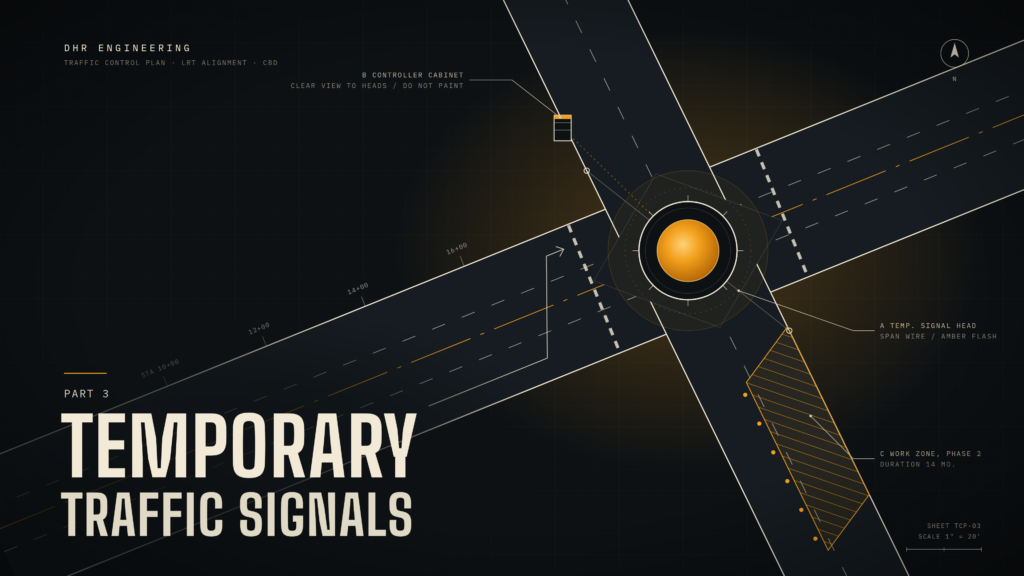
My consulting engineering experience up to this point was only to produce traffic control plans on paper during the design phase of a project, as opposed to administering traffic control, much less on one of the largest transit projects on the North American continent. Perhaps the most foreign concept to me was that of the temporary traffic signal. Up to that point, I had been splitting up a road into two: moving traffic onto one side, building the other, then reversing the process. In this case, I had work zones that were not always parallel nor perpendicular to traffic flow, intersections that were not orthogonal, and long work phases, sometimes extending into months (or, in the case of some of the transit stations along the light rail alignment, years) of work.
Existing traffic signals could, in the simplest of cases, be turned to an amber or a red flash (HINT: don’t ever call it “yellow” in the traffic industry. To this day I don’t know why). However, higher volumes of traffic in the Central Business District and periphery required phased signaling. This was accomplished through connection to the signal controller cabinets, which, to that point, I hadn’t really paid attention to. They were non-descript, metal boxes on the corner of the intersection. I did learn a few things about them, anecdotally, from spending time in City Hall’s Traffic Management Center, the central command for the city’s over 1,300 traffic signals. One design tip was to always situate the cabinet such that it could be opened by a field engineer with a clear view of the signal heads and traffic proceeding through the intersection. The other was physical. During the 1984 Republican National Convention, the City of Dallas had painted the traffic si