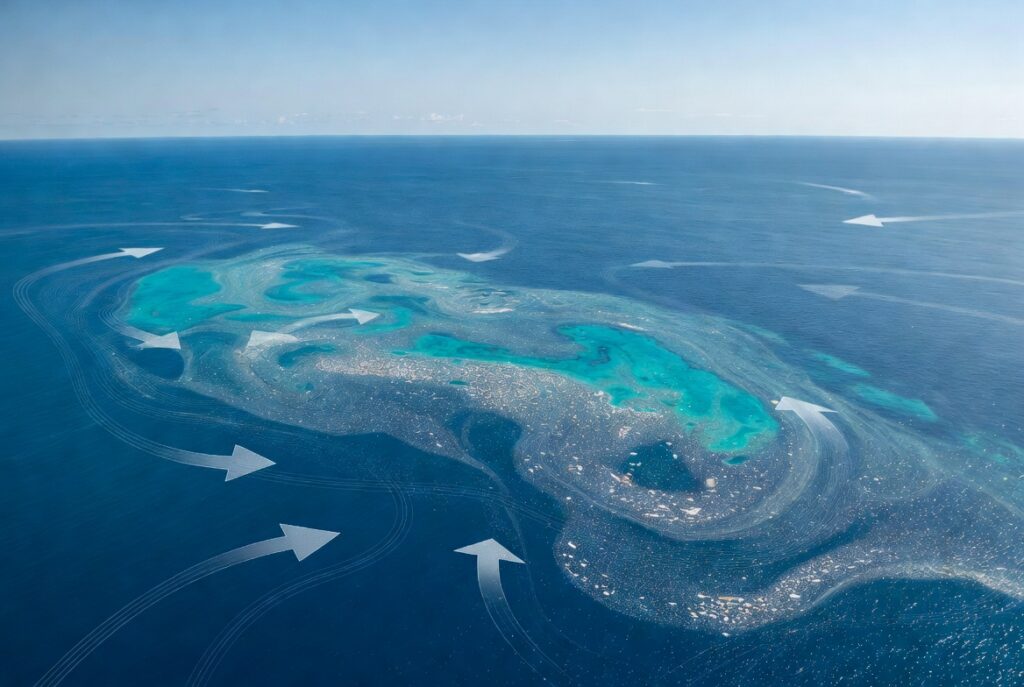
The Great Pacific Garbage Patch (GPGP) is not a discrete island of debris, but a dynamic, diffuse accumulation of floating plastics and other anthropogenic materials within the North Pacific subtropical gyre. For engineers, it represents a systems-level failure spanning materials science, product design, waste management infrastructure, and oceanographic transport processes. Understanding the GPGP requires integrating fluid mechanics, polymer degradation behavior, and global logistics networks.
The patch forms primarily within the gyre bounded by the North Pacific Current, the California Current, the North Equatorial Current, and the Kuroshio Current. These rotating currents create a region of weak horizontal mixing and convergent surface flow. From a fluid dynamics perspective, Ekman transport plays a central role: wind-driven surface layers move at an angle to prevailing winds, resulting in net inward transport toward the gyre center. The result is a quasi-stagnation zone where buoyant debris accumulates over decades.
Unlike traditional solid waste landfills, the GPGP is vertically stratified and spatially heterogeneous. Engineers often underestimate the importance of microplastics—particles less than 5 mm in size—which comprise the majority of the total particle count. These fragments originate from the photodegradation and mechanical breakdown of larger items such as fishing nets, packaging, and consumer goods. Ultraviolet radiation induces chain scission in polymers like polyethylene and polypropylene, reducing molecular weight and embrittling the material. Wave action and thermal cycling then fragment the debris into progressively smaller particles.
From a mass balance standpoint, inputs to the GPGP are dominated by land-based sources, estimated at 70–80%, with the remainder from maritime activities such as fishing and shipping. Rivers act as primary conduits, transporting mismanaged plastic waste from urban and industrial regions into the ocean. The engineering failure here is twofold: inadequate waste collection systems in rapidly urbanizing regions, and insufficient interception mechanisms at river mouths. Once in the open ocean, retrieval becomes exponentially more difficult due to dispersion and fragmentation.
The persistence of plastics in the marine environment is a direct consequence of their chemical stability and low density. Most commodity plastics are hydrophobic and resist microbial degradation. Their densities—typically between 0.90 and 0.96 g/cm³—allow them to remain buoyant in seawater (density ~1.025 g/cm³), at least until biofouling alters their effective density. Over time, colonization by microorganisms, algae, and small invertebrates increases particle mass, causing some debris to sink below the surface. This creates a vertical flux of plastics into the mesopelagic zone, complicating quantification and remediation.
For engineers evaluating mitigation strategies, the GPGP poses unique challenges. Traditional “end-of-pipe” solutions are ineffective at oceanic scales. Mechanical collection systems, such as floating booms and skimmers, must contend with low debris concentrations (on the order of kilograms per square kilometer), high wave energy, and the need to avoid bycatch of marine organisms. Systems deployed by organizations like The Ocean Cleanup rely on passive concentration using long floating barriers that exploit relative motion between water and debris. While promising, these systems face limitations in durability, scalability, and lifecycle environmental impact.
A more effective engineering approach emphasizes upstream interventions. This includes redesigning materials for degradability or recyclability, improving solid waste management infrastructure, and implementing riverine capture systems. For example, trash interceptors installed in major rivers can significantly reduce plastic flux into the ocean. These systems must be designed for variable flow conditions, debris loading, and maintenance constraints, often in resource-limited settings.
Material innovation also plays a critical role. Biodegradable polymers, while often proposed as a solution, must be evaluated carefully. Many so-called biodegradable plastics require industrial composting conditions and do not degrade effectively in marine environments. Engineers must therefore consider not only material properties but also the end-of-life pathways and the environmental conditions in which degradation is expected to occur.
From a systems engineering perspective, the GPGP highlights the need for lifecycle analysis and global coordination. The problem is not localized; it is the cumulative result of billions of individual decisions across supply chains, consumer behavior, and policy frameworks. Effective solutions require integration across disciplines: civil engineering for waste infrastructure, chemical engineering for materials design, environmental engineering for impact assessment, and ocean engineering for monitoring and remediation technologies.
In conclusion, the Great Pacific Garbage Patch is less a singular phenomenon than a manifestation of systemic inefficiencies in how society produces, uses, and disposes of materials. For engineers, it serves as a case study in unintended consequences at planetary scale. Addressing it requires shifting focus from downstream cleanup to upstream design and management, leveraging engineering principles to reduce waste generation, improve capture, and ultimately prevent accumulation in the marine environment.