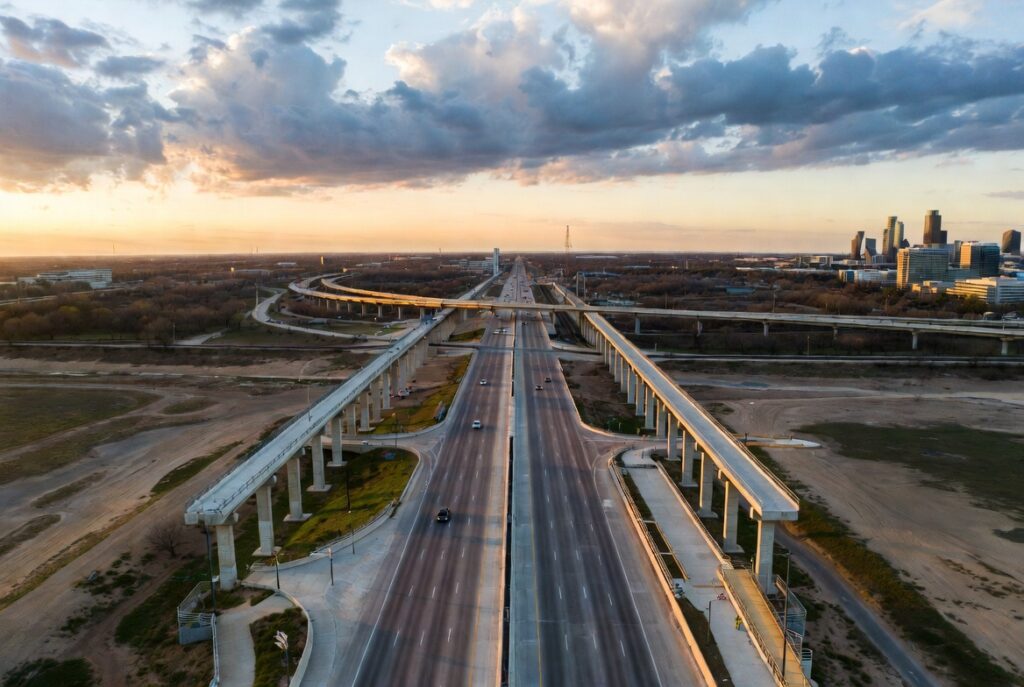
I was 30. I had just moved to the Transportation Office at the City of Dallas, over from Stormwater Management. I had worked and gotten some experience in flood control, floodplain, wetlands, and storm drainage, and wasn’t really aware of the magnitude of projects that lay in front of me at City Hall. Just the move in and of itself was exciting: from the old telephone exchange building on Jefferson Street, to the modern, I.M. Pei-designed City Hall, downtown, in the heart of Dallas.
The program that I was assigned to was “Interagency Coordination”, a less-than-impressive name for a more-than-impressive cluster of projects, dealing with any combined public work between the City of Dallas and one of its fellow government agencies (the Texas Department of Transportation, Dallas Area Rapid Transit, Dallas County, adjacent cities, the North Central Texas Council of Governments, Dallas Water Utilities, and the franchise utility companies (Atmos Energy, Oncor, AT&T, and a cluster of smaller entities).
These projects, by definition, were the largest in the city, often involving federal monies, thus involving the Federal Highway Administration, the Federal Transit Administration, the U.S. Army Corps of Engineers, the Federal Emergency Management Agency, and others. The list goes on, and the purpose of the introduction is to underscore the magnitude of the effort.
These projects took more time than others, and one project in particular, a bridge spanning the Trinity River, connecting West Dallas with U.T. Southwestern Medical Center, crossing I-35 (the Stemmons Freeway) and the Rock Island Railroad, stood out amongst many other large public works projects. I remember my boss telling me “if you can survive this project, you can survive anything”.
Funding originated in the 1980s, and TXDOT had done engineering design in-house. There were street reconstruction, utility relocation and replacement, temporary and permanent traffic signals, temporary lighting for a helipad at the hospital, and railroad coordination, but the hallmark of the project was the bridge, three-quarters of a mile crossing the Trinity River levees and floodway.
The old bridge was four lanes of concrete deck on a steel frame, sitting on concrete piers. The new bridge was to increase capacity to six lanes (three in each direction), with pedestrian and bicycle capacity, and would be raised to higher grade relative to the top of the flood control levees.
Ed Bell Construction had been awarded the project, TXDOT was the lead entity letting the job, and I was the City of Dallas point of contact managing construction.
Calls would come in: “David, there are holes in the old bridge deck from aging and wear-and-tear, do you want to set a metal plate over the holes or divert traffic and point repair the holes?”. These were questions that both awed and scared me, and I did me best to keep up with them, and provide the most well-research, vetted-by-senior-engineers answers that I could, but, at the same time, I also learned that, while I had always assumed that there was some all-knowing entity at City Hall who could respond to such questions, there was, in fact, not, and the city relied upon the good engineering judgment, analysis, and thinking of staff like me (assisted, of course, by my boss and other seasoned engineers).
I remember going to the site the day that demolition of the old bridge began. The existing deck had literally been sawed in half, taking the existing span from four lanes to two (only one in each direction, far less capacity than needed for the daily AM and PM commutes). Construction would need to proceed rapidly, because the complaint calls and emails about delays would now start pouring into my phone and email! As I stood on the river bottom looking up at the piers to be demolished, the steel salvaged and sold in China, and the footings abandoned in the ground, the construction plans I looked at seemed academic, even abstract. However, over the course of the next three years, they would slowly (and not always steadily due to utility conflicts) proceed toward a final product. I was cutting my teeth as a newly-minted registered professional engineer.