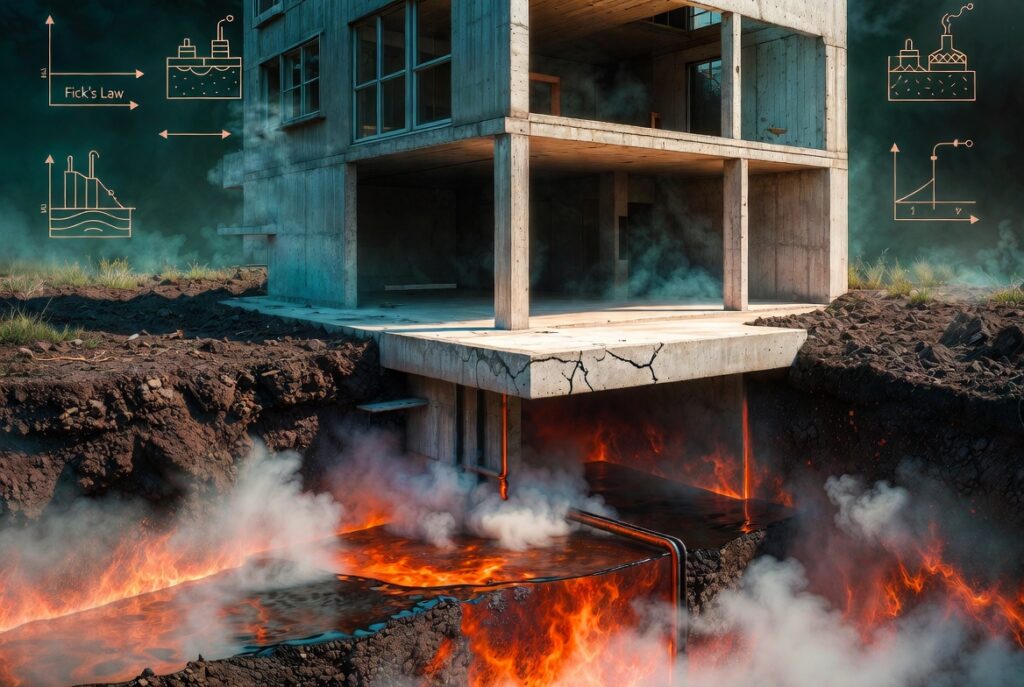
Vapor intrusion (VI) is the process by which volatile chemicals migrate from contaminated subsurface media—typically soil or groundwater—into overlying buildings. From an engineering standpoint, vapor intrusion represents a coupled transport problem involving multiphase flow, diffusion, and pressure-driven advection through heterogeneous porous media and across building envelopes. It is most commonly associated with volatile organic compounds (VOCs) such as trichloroethylene (TCE), perchloroethylene (PCE), benzene, and petroleum hydrocarbons.
The conceptual site model (CSM) is the foundation of any VI evaluation. Engineers begin by identifying three key elements: a contaminant source (e.g., dissolved plume or residual soil contamination), a migration pathway (vadose zone soils, utility corridors, fractures), and a receptor (occupied structure). The vadose zone—unsaturated soil between the ground surface and groundwater table—is the primary medium governing vapor transport. Soil texture, moisture content, and permeability strongly influence whether diffusion or advection dominates.
Diffusion is often the primary transport mechanism in low-permeability soils. Governed by Fick’s Law, contaminant flux is proportional to the concentration gradient and the effective diffusion coefficient of the soil matrix. Fine-grained soils (clays, silts) tend to suppress advective flow but still permit slow diffusive migration. In contrast, coarse-grained soils (sands, gravels) can support advective transport when pressure gradients are present. These gradients may arise from wind loading, temperature differences (stack effect), or mechanical systems within buildings that create negative indoor pressure relative to subsurface conditions.
From a building science perspective, the structure itself is a critical control volume. Most vapor intrusion occurs through preferential entry points: cracks in slabs, construction joints, utility penetrations, sump pits, and floor-wall interfaces. Even well-constructed slabs are not vapor barriers in a strict sense; concrete is semi-permeable and can allow diffusion, though at reduced rates compared to open pathways. Engineers often treat the building slab as a boundary condition in modeling, with entry governed by both permeability and pressure differential.
Screening and assessment typically begin with soil gas sampling. Sub-slab or near-slab vapor probes are installed to measure contaminant concentrations directly beneath the building footprint. Groundwater data may also be used with attenuation factors—empirical or modeled ratios that estimate indoor air concentrations based on subsurface levels. The U.S. EPA’s Johnson and Ettinger (J&E) model is widely used as a screening tool. It simplifies the system into one-dimensional transport and steady-state conditions, incorporating parameters such as soil permeability, building dimensions, air exchange rate, and contaminant properties (Henry’s Law constant, diffusivity). While useful, engineers recognize its limitations, particularly in heterogeneous soils or where transient conditions dominate.
Indoor air sampling is the most direct measure of exposure but is complicated by background sources. Household products, building materials, and occupant activities can contribute VOCs, making it difficult to distinguish subsurface contributions. This necessitates a weight-of-evidence approach combining sub-slab data, indoor air results, and temporal trends. Engineers often use paired sampling and pressure measurements to correlate building conditions with contaminant entry.
Mitigation strategies focus on interrupting the pathway or reducing driving forces. The most common system is sub-slab depressurization (SSD), analogous to radon mitigation. A network of perforated piping is installed beneath the slab and connected to a fan that creates negative pressure relative to indoor air, effectively reversing the gradient and preventing vapor entry. From an engineering design standpoint, SSD requires consideration of sub-slab permeability, pressure field extension, and long-term reliability of fans and seals. Diagnostic testing—such as pressure field extension testing—is used to verify that the system induces sufficient negative pressure across the entire footprint.
Vapor barriers and passive venting systems are often incorporated into new construction in areas with known or potential contamination. High-density polyethylene (HDPE) membranes can provide low-permeability barriers, but installation quality is critical; seams, penetrations, and damage during construction can compromise performance. Passive systems rely on natural pressure gradients and may be converted to active systems if needed.
In more complex cases, mitigation may extend beyond the building. Source remediation—such as soil vapor extraction (SVE), air sparging, or groundwater treatment—can reduce contaminant mass and long-term vapor flux. However, these approaches are typically more costly and time-intensive, and they must be evaluated in the context of overall site risk and redevelopment goals.
Regulatory frameworks for vapor intrusion have evolved significantly over the past two decades. Agencies now emphasize proactive evaluation, particularly for redevelopment of brownfield sites. Engineers must navigate varying state guidance levels, screening criteria, and risk thresholds, often incorporating conservative assumptions to protect sensitive populations.
Ultimately, vapor intrusion is a multidisciplinary engineering challenge that bridges geotechnical engineering, environmental chemistry, and building science. Effective management depends on a robust conceptual model, careful field characterization, and appropriately designed mitigation systems. As urban infill and redevelopment continue, especially on legacy industrial sites, VI will remain a critical consideration in ensuring safe and sustainable land use.